The muFFin Generation!

April 15, 2011
There is a definite visible change in the body structure of urban Indians, especially youngsters, that makes me write this.  I don't want to offend anyone. But, surely want to draw attention to that increasing width of waist, which manages to protrude out of T-shirts, tops and Kurtas alike.
 

The muffin and the muffin top

I'm talking about the accumulation of fat around the waist, specially visible on both sides of the  waist, seen from the front.  The body ie torso then looks like an inverted muffin. 

Our body stores fats, which is a normal thing, as it has to prepare itself for exigency conditions when we can be deprived of food and hence works as a store house for emergency.  Now, where do we store the fat in our body depends on many factors, and I've read that it's mostly our genes which decide whether we'll have that thick neck and well padded shoulders, or heavy thighs or bottom or well rounded arms (seen in women) or it would be the waist area.

Life style also plays an important role in deciding where we put on that fat.  Needless to say, we are a lazy generation, button generation, couch potatoes - earlier glued to TVs and now stuck to PCs and gadgets.  We love our fast food like God.  I feel very surprised when I see young people grabbing a pack of potato chips and a soft drink when hungry, my children being no exception.  It's so fashionable to be hanging out at a popular fast food joint and ordering junk food.  (I too like it very much, but I know when to treat myself and when to stick to home cooked simple food).

So, the final line is that due to such factors, a whole generation ( the urban, i mean) has a strange body type, which is not at all flattering.  Add to it the beer guzzling habits, most young boys have a beer belly.  Now, if you observe the bodies of men and women now, you'll find that since all the fat is going to the waist line and tummy area, the bum is shrinking... and that can be a party pooper!! Girls wearing a Saree without a well balanced figure (read bulged tummy, thick waist, and no bottom) can be devastating.  The same happens with both guys and girls when they are in western dresses.


The muffin top must have got its name due to this body shape!

The changed life style has affected the hormones too.  Now the age of puberty for girls has gone down.  Girls are attaining puberty at the age of 8-9, due to various environmental factors and obesity.  And this shift has come in last 15 years or so.

Don't want to give you a "hamare zamane me moment" (!!!) but, since girls were expected to work at home assisting the mother and junk food was not at all prevalent, girls were very lean and slim till the time they were married.  But thanks to the myths related to pregnancy, they would collect fats all over their bodies during child bearing and rearing age.

So guys, think about it. Have junk food but remember that should only be meant to reward yourself, pleasure yourself or for celebration time.  For rest of the times having light and nutritious food is the best bet. 

If you love yourself, feed yourself well.  Eat food for your tummy and not your tongue!


RESTLESS

Kanya Pujan -A View On The Hindu Ritual of Virginity and Divinity

April 13, 2011
With each passing year I'm finding Kanya Pujan (or Kanjak) meaningless.  With each passing year, I'm getting more and more disinterested in this Hindu ritual, when on a given day, we have to worship small virgin girls.  And this year, for the first time, I was vocal about my thoughts to my family.

In the following paras, I have elaborated about the ritual, the legend behind it, and its religious importance.  If you already know it, you can jump to Changing times and Kanya Pujan (below)

What is Kanya Pujan?  

Hindus observe Navratras (meaning nine holy nights) and during these days they worship Goddess Durga.  On each day one of the nine dimensions of the Goddess are worshipped.  On the eighth and ninth day,  virgin girls till the age of puberty and the one's who have not attained puberty, are worshipped.  This ritual is called Kanya Pujan (meaning worshipping the girl). 

Goddess Durga
The Legend of Kanya Puja -

As per the Hindu scriptures, Kumari Puja is observed to rememorize the demolition of the demon Kalasura by the Goddess Maha Kali. Legend tells that the demon Kolasura occupied the heavens and the earth. All Gods were helpless and tired with the bad actions of Kolasura. They approached Goddess Mahakali for help. The goddess was born again as Goddess Durga Devi and demolished Kolasura. Devotees perform dances and special aartis during the celebration of Kumari Pooja.

Why a virgin girl (who has not attained puberty) is worshipped?

Hinduism believes in the universal creative forces to be feminine gender. The very original force is Mahamaya whose inspiration created the gods and the rest of the cosmos. The inspiration is the life force of the entire creation. All the major and minor energies and forces are represented by various goddesses. Thus, a virgin girl is the symbol of the pure basic creative force according to this philosophy.

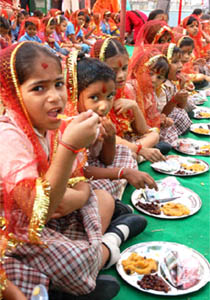
Girls worshipped and fed as Kanjaks
In a kanya (virgin girl)  the great feminine potential is at its peak. Having developed into a girl of a certain age and before attaining puberty, a female child is considered the most auspicious, the most clear minded and clear souled individual.

While invoking the parashakti in such a form the purity of mind body and spirits is required and is fulfilled by a girl child of the said age of 8+ before reaching puberty. Such a female child is indeed Devi, who in her later life takes the roles of Parvati as a wife and mother, Lakshmi as a housewife, Saraswati as the first guru of her children, Durga as the destroyer of all obstacles for her family, Annapurna as the food provider through her cooking, Kali as the punisher to bring the members of the family on the right track, so on and so forth...

Where all in India is it observed? What's the ritual?

Some of the regions in India that observe Kanjak Ashtami are Chandigarh, Haryana, Punjab, Uttarakhand and Himachal Pradesh.

Ritual - 5 or 7 or 11 small girls from the neighbourhood are invited at home.  The lady of the house performs the ritual with the help of other people in the family.  The feet of girls (referred as Kanjaks) are washed with milk and water, vermilion tilak is applied on the forehead, Mouli (the holy thread) is tied on their wrist.  They are offered delicious food, traditionally - Poori, Halwa and Chana, and some gifts and money.  Lastly, the couple touches the feet of the Kanjaks and take their blessings.

In eastern states like Bengal , Assam , Orissa and parts of Bihar the ritual is a bit different . Ritual - A single girl is chosen from Brahmin caste with auspicious signs and pleasant looks to be decorated as a goddess . Then she is brought to the place where worship of Devi has already been going on and the rituals are then conducted on her . She is offered all the sixteen items of worships and showered with lavish gifts to please her , like chocolates , dresses , jewellery , toys , cosmetics etc .

Changing times and Kanya Pujan -

First of all, due to skewed sex ratio in most the northern Indian States or I don't know for what reason, finding young girls in many localities is a difficult thing.  Secondly, as its regular school days, so all the kids are off to school.  The only strata left out from schooling is the children of maids and other unskilled labours, who live in some slum or urban village (as we call them) around. (Definitely, it talks about the conscience of convenience that we all have.  That day, we don't mind that these under privileged kids are not going to school).

Honestly speaking, inviting those unwashed, unclean kids with tattered clothes and unkempt hair and an equally repulsive odour to your place can be quite cumbersome.  And following the ritual with true devotion can be very challenging or you have to be religiously religious for it... I doubt how many of us would be doing that.... I'm sure most of us serve food and offer money to them with pity than with the great bhakti bhavana (religious feelings).

Finally, the only option left with a busy, working couple, is to cook all the dishes and go to the nearest temple to either give to the priest to distribute to small girls during the course of the day or again find some small beggar girl and give the food and money to her.  We ultimately resort to giving alms or best put - to beggary.

This was about the ritualistic part only, which makes it worthless in my eyes.  Femininity as divinity is only fashionable thing to say, nothing more than that.

Talking about why I'm so uninterested now is because of one apparent reason, which does not need any elaboration.  The ever growing violence against females - foeticide, infanticide, sexual abuse of minor girls (Digital rape is a new term I came to know about), rape, sexual offenses, ill treatment because of the gender. 

This year, while I walked towards the temple to offer the food etc for Kanjaks, the news of a three year old girl, raped and killed, kept banging in my head. I bowed my head in front of the idol of the goddess Durga and came back soon..... how does it matter whether some people worship the girls.... they actually don't need them.


RESTLESS

pics coutesy: google images

Jantar Mantar - Snapshots

April 7, 2011
We Delhites love to go shopping, mall hopping and movies.  Also, the one common factor which binds a common Dilliwala is the love for the street food.  So, mostly a family outing means, you go any place where you can eat, shop or chill, in any order!

But, I've always tried that apart from going to such fun places, me and my kids go to some educationally interesting places too.

Recently, we visited Jantar Mantar at New Delhi.  Today, as on date ie., it is the hub of socio political happenings in the Capital. Have a look at the majestic look of Jantar Mantar.  Interestingly, Park Hotel stands just behind it, and brings out the contrast - ie.,  ancient and modern.


RESTLESS

A Lesson From My Teenager Son

April 5, 2011
My 14+ years old son tells me " Ma, aap bahut bholi ho, kuch nahi samajhti".

This has completely shocked me!!  I was sitting on the sofa reading a volunteer form for parents provided by his school,  next to his almirah, where he was keeping his books. His words completely jolted me, and not to mention, I had my eyes popping out in surprise and my jaw dropped for a good few seconds, when I heard that!

Hey, wait a second boy! suddenly my causal, comfortable capri  and top is feeling like a pale coloured, worn out, crinkled, dull cotton saree, worn over an ill fitting blouse of same shade..... and suddenly I'm feeling very old..... old and rusted from mind....

Seriously, for a moment I'm reminded of the good old (well, literally) Nirupama Roy of old Hindi movies... the poor mother... the idol of sacrifice, the affectionate but weak mother, who always stayed at home and really didn't know much about the bad bad world outside, always standing by her family.... the good old Nirupama Roy.... me?! And the young and tall son tells her " Ma, tum kitni bholi ho, tum kuch nahi jaanti"

And hey.... I've heard these words before.... I think I used to tell my mom the same thing (err... may be I used to think of telling this to her some day!!)....I was pretty sure I don't want my children to tell me that I DO NOT know the world around. But I'm quite sadly surprised that I have to hear this.... despite everything. (!!!)

And now hear, why I had to hear this.  My son has got a form from his school, in which parents can volunteer to help the school/students in any way, in terms of a motivational talk or counselling or anything (at least this is what i could make out of that brief form).  Since, I impart training in soft skills (along with my main work profile) I thought I could contribute in a way so as to have an interactive session with my son's classmates of Class X.

But, I was not surprised that he discouraged me to volunteer. Rather I was taken aback my son's comment, followed by this great revelation - "Mom, only behenjis will be suitable for that.... remember I'm in Xth class.... I have grown up, big boys as my class mates........(a suggestive smile)..... they can say just anything.... so please don't volunteer".

I closed my mouth... collecting my dropped jaw.... and said - "Son, they are 15 year old kids and I'm your mom, and for God's sake I'll be dressed up in a Saree when I go to your school.... what's the matter?.... you mean the boys will.........( looked at him in a confused way)

Thud came the reply - "aap kuch nahi samajhti..... Mom, please don't, and please listen to me this one time"


I'm yet to come with terms with this one!  Times have really changed.... and I'm feeling way behind the times!!!!!

Of course, the next generation has to be way more smart than the previous one, but as a person, I'm, perplexed to experience this change.

Have you ever felt like this as a parent? 


RESTLESS


प्रेम और वसंत

April 4, 2011


घर के सामने लगे उस पेड़ को
देखा था कुछ रोज़ पहले
सूखी निष्प्राण से शाखाओं को
जैसे जीने की कोई तलब ही  नहीं थी

हर पांत सूखी थी
काँटों से भरा था उसका बदन
और छुपी थी उसमे टूटन और
दिल को चीरती से उदास चुभन

आज सुबह ऑंखें मलते
बाहर जा कर देखा तो पाया
सूखी शाखों में कुछ नवजात पत्तियां
सुर्ख रंग की, उग आई हैं

हर वर्ष, परत दर परत
बढ़ते, फैलते, पर बूढ़े होते तने में
यौवन अब भी बाकी था
ऊष्मा अब भी बाकी थी

प्रेमी वृक्ष के सीने में
कुछ थे शायद  उमड़े आज अरमान
कि, शर्मा के प्रेयसी, पत्तियों
का हुआ ये हाल  

हर वर्ष वसंत आता है
हर वर्ष - निष्प्राण, विह्वल दिखती वनस्पति
फिर सजक हो जाती है
फिर प्रेम कर बैठती है
फिर हरी भरी  हो, लहलहा जाती है

हम मनुष्य ही क्यूँ
टूटे ह्रदय को
परत दर परत सीने में दफ़न किये जाते हैं ?
क्यूं भूल नहीं जाते किसी का मुह मोड़ लेना ?
क्यूं  माफ़ नहीं कर पाते किसी के कड़वे शब्द ?

क्यों नहीं ओढ़ लेते हरियाली की चादर ?
हरीतिमा का आंचल ?
हर वसंत....
हर वसंत....
हर वसंत....


RESTLESS

Forget About the Borders - Let Cricket Win

April 2, 2011
I'm not a sports enthusiast.... but can absolutely understand others' interest in sports (read cricket)... it's understandable.

I'm dying to go watch another photo exhibition in IGNCA, New Delhi.... so I can very well understand the passion of the masses world wide for watching sports matches etc. I can very well understand why people plan their days to be able to view their favorite match..... and it's even more apparent when the match happens to be between India and Pakistan ( I know I'm late for saying that!) .... and much more obvious when their Blue Gods are eying the ICC World Cup (or any such cup or saucer which is in vogue those days).

I understand it all.  BUT, what I absolutely fail to understand is that why do we have to make a cricket match sound like some war??  I keep wondering.... and wondering..... and wondering.... just what makes people think that winning a match by any team is going to serve as an ego booster for an ordinary man on the street? Is it going to change their life in some way?


I want to ask you, the reader, have we not started making these matches a question of our self respect, ego, country's worth etc etc?

Wont' believe me? or you do?

Sample this, that some leading FM channel, says its a war out there.... and we HAVE to win.... to tell us listeners - what is your totka (home made recipe to achieve some goal)  for India to win?! Helllllowwww!!! better ask for a totka to stop people jumping queues.... better ask for a totka to instantly blacken the face of the guys who trouble and harress the girls in public places.... we desperately these and many more such totkas (huff, as if they work!!! Gosh, when we really become educated?!)

Sample this, and I'm pretty sure, you have already got such SMSs and you have already forwarded them the Nth time! The SMS jokes which show the opponent team and captain in poor light, almost denigrating them on personal level. Being a public figure does not mean, they can be dragged into anything at the mass's will, come on, don't we know this??

Why are we, the ordinary people of this country, of any country, so obsessed about WINNING and not about the GAME?? This is my question to all the sports fans out there?  Why can't we watch a match with the true sportsman spirit.  The game should be played with all fairness and enthusiasm.  Of  course the aim is to win..... but the bigger aim is to be a team player.... the bigger aim is to be a student of that discipline which you have chosen for your life ( if you're a professional player, i mean).

And NO, we can't do that, so comes the COMPULSION and not  the DESIRE to win... the pressure of your nation is there, so you HAVE TO  win.   Just why??

And, Here, I'm not even talking about the betting on teams and the huge business going on, as we hear and read in newspapers everyday.

It seems the we have not gotten over the cricket match played between Bhuvan (Amir Khan) and the British officers in the movie Lagaan.... which of course was a match which would have decided their fate - it was a question of  life and death for them - I really feel, that is how generally cricket is viewed even now.  We have to get over that.... these are just friendly matches...... let our egos not come in between the pure pleasure of a game.

Finally, just want to say that, let's not go mad about WHICH TEAM SHOULD WIN..... let's rise above that and say LET THE GAME WIN - LET CRICKET WIN.


RESTLESS


Are You Prepared To Face The Earthquake?

March 28, 2011
I wrote two  posts about our (lack of) preparedness for disasters and another one giving a brief overview of Disaster Management, as a concept.  I continue with the series of posts, doing my bit, in creating awareness amongst the readers around, so as to spread the word of precaution and care that a person can take as an INDIVIDUAL.  Let's take our baby steps towards knowing the dangers, the threats and safeguarding ourselves and our families.  Please share the post with your loved ones and show your concern for their well being. In this post, I cover the natural disaster called Earthquake.

What is an Earthquake?

An earthquake is a phenomenon that occurs without warning and involves violent shaking of the ground and everything over it. It results from the release of accumulated stress of the moving lithospheric or crustal plates. The earth's crust is divided into seven major plates, some 50 miles thick, which move slowly and continuously over the earth's interior and several minor plates.

Earthquakes are tectonic in origin; that is the moving plates are responsible of the occurrence of the violent shaking. The occurrence of an earthquake in a populated area may cause numerous casualties and injuries and extensive property damage.

Situation in India (In brief)

As per the current seismic zone map of the country (IS 1893: 2002), over 59 per cent of India’s land area is under threat of moderate to severe seismic hazard, i.e., prone to shaking of MSK Intensity VII and above (BMTPC, 2006). In fact, the entire Himalayan belt is considered prone to great earthquakes of magnitude exceeding 8.0, and in a relatively short span of about 50 years.

The North-Eastern part of the country continues to experience moderate to large earthquakes at frequent intervals.

The increase in earthquake risk is also caused due to a spurt in developmental activities driven by urbanization, economic development and the globalization of India’s economy.

  
Earthquake Survival And Damange Reduction

The damge of an earthqake can be reduced by knowing some simple and vital information about the place where you live.  You should know the following:

 - Whether tremours or earthquakes have occurred in your area and with what damage?
 - Get a map showing India's earthquake hazard zones. (see above)
 - Even if you are in a low risk zone, get some information on how to make your house more safe.
 - Check that your insurance covers earthquake damage.

Watch for Indicative Signs:

Erratic animal behaviour - Watch for frightened or confused pets running around, or a birdcall ot usually heard at night.
Groundwater levels - Watch for sudden changes in water level in wells or artesian bores.

What to Do Before an Earthquake
  • Repair deep plaster cracks in ceilings and foundations. Get expert advice if there are signs of structural defects.
  • Anchor overhead lighting fixtures to the ceiling.
  • Follow BIS codes relevant to your area for building standards
  • Fasten shelves securely to walls, as they fall on people during earthquake. 
  • Place large or heavy objects on lower shelves.
  • Store breakable items such as bottled foods, glass, and china in low, closed cabinets with latches.
  • Hang heavy items such as pictures and mirrors away from beds, settees, and anywhere people sit.
  • Brace overhead light and fan fixtures.
  • Repair defective electrical wiring and leaky gas connections. These are potential fire risks.
  • Secure a water heater, LPG cylinder etc., by strapping it to the wall studs and bolting it to the floor.
  • Store weed killers, pesticides, and flammable products securely in closed cabinets with latches and on bottom shelves.
  • Identify safe places indoors and outdoors.
    1. Under strong dining table, bed
    2. Against an inside wall
    3. Away from where glass could shatter around windows, mirrors, pictures, or where heavy bookcases or other heavy furniture could fall over
    4. In the open, away from buildings, trees, telephone and electrical lines, flyovers, bridges
  • Educate yourself and family members
  • Know emergency telephone numbers (doctor, hospital, police, etc)

Have a disaster emergency kit ready
    1. Battery operated torch
    2. Extra batteries
    3. Battery operated radio
    4. First aid kit and manual
    5. Emergency food (dry items) and water (packed and sealed)
    6. Candles and matches in a waterproof container
    7. Knife
    8. Chlorine tablets or powdered water purifiers
    9. Can opener.
    10. Essential medicines
    11. Cash and credit cards
    12. Thick ropes and cords
    13. Sturdy shoes
 Develop an emergency communication plan
    1. In case family members are separated from one another during an earthquake (a real possibility during the day when adults are at work and children are at school), develop a plan for reuniting after the disaster.
    2. Ask an out-of-state relative or friend to serve as the 'family contact' After a disaster, it's often easier to call long distance. Make sure everyone in the family knows the name, address, and phone number of the contact person.
What to Do during an Earthquake

Stay as safe as possible during an earthquake. Be aware that some earthquakes are actually foreshocks and a larger earthquake might occur. Minimize your movements to a few steps to a nearby safe place and stay indoors until the shaking has stopped and you are sure exiting is safe.

If indoors
  • DROP to the ground; take COVER by getting under a sturdy table or other piece of furniture; and HOLD ON until the shaking stops. If there isn’t a table or desk near you, cover your face and head with your arms and crouch in an inside corner of the building.
  • Protect yourself by staying under the lintel of an inner door, in the corner of a room, under a table or even under a bed.
  • Stay away from glass, windows, outside doors and walls, and anything that could fall, such as lighting fixtures or furniture.
  • Stay in bed if you are there when the earthquake strikes. Hold on and protect your head with a pillow, unless you are under a heavy light fixture that could fall. In that case, move to the nearest safe place.
  • Use a doorway for shelter only if it is in close proximity to you and if you know it is a strongly supported, loadbearing doorway.
  • Stay inside until the shaking stops and it is safe to go outside. Research has shown that most injuries occur when people inside buildings attempt to move to a different location inside the building or try to leave.
  • Be aware that the electricity may go out or the sprinkler systems or fire alarms may turn on.
  • DO NOT use the elevators.
If outdoors
  • Stay there.
  • Move away from buildings, trees, streetlights, and utility wires.
  • Once in the open, stay there until the shaking stops. The greatest danger exists directly outside buildings, at exits, and alongside exterior walls. Most earthquake-related casualties result from collapsing walls, flying glass, and falling objects.
If in a moving vehicle
  • Stop as quickly as safety permits and stay in the vehicle. Avoid stopping near or under buildings, trees, overpasses, and utility wires.
  • Proceed cautiously once the earthquake has stopped. Avoid roads, bridges, or ramps that might have been damaged by the earthquake.
If trapped under debris
  • Do not light a match.
  • Do not move about or kick up dust.
  • Cover your mouth with a handkerchief or clothing.
  • Tap on a pipe or wall so rescuers can locate you. Use a whistle if one is available. Shout only as a last resort. Shouting can cause you to inhale dangerous amounts of dust.
After an earthquake
  • Keep calm, switch on the radio/TV and obey any instructions you hear on it.
  • Keep away from beaches and low banks of rivers. Huge waves may sweep in.
  • Expect aftershocks. Be prepared.
  • Turn off the water, gas and electricity.
  • Do not smoke and do not light matches or use a cigarette lighter. Do not turn on switches. There may be gas leaks or short-circuits.
  • Use a torch.
  • If there is a fire, try to put it out. If you cannot, call the fire brigade.
  • If people are seriously injured, do not move them unless they are in danger.
  • Immediately clean up any inflammable products that may have spilled (alcohol, paint, etc).
  • If you know that people have been buried, tell the rescue teams. Do not rush and do not worsen the situation of injured persons or your own situation.
  • Avoid places where there are loose electric wires and do not touch any metal object in contact with them.
  • Do not drink water from open containers without having examined it and filtered it through a sieve, a filter or an ordinary clean cloth.
  • If your home is badly damaged, you will have to leave it. Collect water containers, food, and ordinary and special medicines (for persons with heart complaints, diabetes, etc.)
  • Do not re-enter badly damaged buildings and do not go near damaged structures.

Finally, please remember that you can survive an earthquake and minimise its damage by being aware of it, and being prepared for potential hazards.  An earthquake will be over before you can do much about it.  Most people are killed or injured as they attempt to move during the earthquake and are sttuck by falling or flying objects.  Your chances of avoiding serious injury are highif you remain calm and take shelter as recommended.

Stay Aware - Stay Safe


RESTLESS

Content Courtesy: NDMA
 Promote at INDIVINE.

Disaster Management - An Overview

March 25, 2011
When a  cyclone, or an earthquake or a terrorist attack strikes our world, we all start talking about the ill preparedness of the State in dealing with it or in other words we say the Disaster management was not good.

I have tried my bit to explain the various facets, meanings and usage of various terms related to Disaster Management used by a common man in day to day life ( to begin with).  I shall be writing about what to do to save yourself and your family and your community when a disaster strikes.

But, as a starter, let's see what the terms actually mean....


What is a Hazard?

Hazard is a dangerous event, natural or human induced that could cause injury, loss of life or damage to property, livelihood or environment.  a hazard could be natural, socio-natural or human induced. 

What is a Disaster?

A disaster whether natural or human-induced, is an event which results in widespread human loss.  It is accompanied by loss of livelihood, property causing suffering and loss in a definite area (Say a cyclone)

When Does a Hazard lead to a disaster?

A disaster occurs when the impact of hazard on a section of society is such that the people are unable to cope with the event, causing death, injury, loss of property and/or economic losses. An earthquake, if occurs in a very low populated area like a Desert may not have that impact as it would have in a densely populated city, hence here a hazard can become a disaster.
What is vulnerability?
It is the condition determined by physical, social, economic and environmental factors or processes, which increase the susceptibility of a community to the impact of hazards. People living in highly dense residential areas with bad exit routes are more physically vulnerable. People who are socially and economically under-privileged, obviously living in kutcha houses, or in low lying flood prone areas are more vulnerable.  Also, small children, women, old people are socially vulnerable group which will affected more severely than others.

What is Mitigation?

Mitigation, as we know is 'Any measure taken to minimize the impact of a disaster or potential disaster.  Mitigation can take place before, during or after a disaster, but the term is most often used to refer to actions taken against potential disasters."


How does Mitigation help the society?

Mitigation efforts help the people by creating safer communities and reducing loss of life and property.  Mitigation measures include enforcing strict building codes (in earthquake prone areas), flood proofing requirements, construction of houses away from hazardous areas etc

What is Disaster management?

Disaster Management covers the range of activities designed to maintain control over disasters/emergency situations and to provide a framework for helping people to avoid, reduce the effects of, or recover from impact of a disaster.  These activities may be related to preparedness, mitigation, emergency response, relief and recovery(Reconstruction and rehabilitation) and may be conducted before, during or after a disaster (Source : Living with Risk, UN ISDR 2002)

The various stages of Disaster Management

Finally, just would like to add that more emphasis in our country is on the rescue and relief operations and less on the preparedness to minimize the effect of a disaster. 

Dear reader, a big part of the northern India is in the seismic zone, prone to earthquake, therefore, to start, I shall bring out the points to be taken care of in the advent of an earthquake, the do's and the don'ts and the emergency kit that all households should have.

take care


RESTLESS

INDIVINE LINK - Please promote to spread the word.

Pic credit- GIS devp.net

Seeing Holi Through My Bespectacled Eyes!

March 18, 2011
Last evening a friend of mine asked me what am I doing on Holi (An Indian festival of colours)?  I had been avoiding this question, but now since, her query is accompanied with a dream come true invitation for a grand Holi Party in a farm house of Delhi, with loads of fun and masti, read traditional Holi celebration by many family and friends along with rain dance and delicious snacks (yeah, we all get to hungry after playing for hours),  I cut a sorry face and declined the offer - courtesy my spectacles.

A little girl playing with Holi colours

I went on and on to explain her that how will I feel when someone approaches to colour my face with gulal (dry powered colour)... I'll have to tell him/her to wait, and then I'll take off my specs, close my eyes and let some colour of joy spread on me... and then I'll wait for a second to judge whether it's over or I still have to keep my eyes closed... huff and then smile and dust off some gulal and then again put on my glasses.  And I'll look so funny grinning that way!

She understood..... poor me.... she thought and after exchanging pleasantaries, she hung up.

For the first time I felt, I was missing something badly.... I was missing playing holi.... the fun way.  All these years the desire to have fun with colours and coloured water and ballons and pichkaris was not there, just a customary smear on the cheek would do.  But now, as the age is progressing (!!) I'm feeling like becoming a kid again.  And the biggest impediment between me and my beloved "holi ke rang" is my glasses!  Hey, by the way, glasses really come in between lovers when they want to cuddle up!!

Coming back,  I was imagining me playing holi the old bollywood ishtyle.... there is nothing that beats "rang barse bheege chunar wali rang barse" song of movie Silsila!! Ah, it would have been a real spicy Holi, if I donned a white chudidar kurta with a colourful dupatta, all set with the Holi mood (not to forget those kajal rimmed eyes and some lip gloss too!!) surrounded by family and friends, and the song playing in the background ( no, can't expect anyone singing that for me!)  and acted coy and vibrant like Rekha did!!! ..... but huff, for that I had to wear contact lenses, which I really don't want to do, as the colours can not just ruin my lenses but also cause me eye infection.

People wearing spectacles face a lot of trouble during Holi celebrations.  Even if they wear spectacles, the colour settles in the tiny spaces of the frame.  Wearing a rim-less spectacles on Holi may cause it to break.  Specially children who wear specs feel a lot of discomfort.  So, if you happen to know spectacled people (which I'm sure, you know many) be careful while smearing the colours on their face, and it's better to ask them before hand, or else you could even hurt the person with his/her own spectacles.  Specially be careful with kids.


Have a safe and colourful Holi !

RESTLESS :)

PS: Also, don't forget to apply cream, or oil or vaseline on all the exposed skin to minimise the effect of colours on it. Keep you hair tied up and oiled before playing holi. The vibrant colours of Holi look fabulous on white dresses (Girls can try wearing white top and harem pants)

PPS: Pic courtesy this site.


What Is Our Preparedness For Disasters?

March 17, 2011
The triple whammy of  earthquakes, tsunami and nuclear radiation has hit Japan, but actually it has jolted the whole world.  Firstly, it is the suddenness of natural disasters and secondly the threat nuclear plants can pose in case of crisis situation like this where the electricity to cool the plant is not there and hence making the situation uncontrollable.  Japan, as of today, is dealing with it and we hope and pray that the situation comes under control and the citizens of the country get rehabilitated soon.

But, imagining such a scenario about our country India is really frightening.  The metro cities are so densely populated.  Illiteracy and lack of information as well as awareness in the common man is one of the biggest impediments in dealing with a disaster than may take place.  Not to mention the ill preparation at the authorities end.

But, should we just wait for the State, the authorities to come forward and educate us about the precautions to be taken, or should we, as educated citizens of the country, think about gathering information, forming support groups in areas of our residence (say housing societies, RWAs, local NGOs etc) to find out ways to garner support in case of a natural or man made diaster?  How are we preparing ourselves for a disaster?

These questions did hound me a few years back when I attended an awareness workshop organised  by National Disaster Management Authority of Government of India.  In fact, after attending this workshop, I searched the popular book stores to see what kind of books are being published to make the citizens aware of the preparation to face the natural or man made disaster.  Exposing myself to such information made me more conscious towards the possible precautions to be taken, and the kind of actions required in case of a disaster. (I tried, but still can't say I'm completely ready to face any crisis situation.)

The cover page of the CBSE book for IX class

I sent the brochures and reading material I collected from the exhibition to my son's class teacher, so that she could at least tell the kids about what they should do in case of an earthquake.  I live in Delhi, which is on the seismic zone and hence prone to earthquakes.  But, unfortunately, the teacher took no action at all, and returned the papers.  I guess, teachers are not supposed to expose 5th - 6th class students to such topics... I just guess that, I don't know.

But, much to my delight, CBSE prescribed an additional book on "Disaster Management' for IX and X classes (in social studies) . Thankfully, now, the awareness would be given right from the young age, the schooling days.  And since, I help my son with his studies, it was really very interesting and informative for me to read it.

Although, it came as a sad coincidence, while I was teaching my son about the accidental nuclear radiation and the explosion, he could relate with it, as the pictures of Japan's Fukushima Nuclear Reactor were there in the newspaper that day.

Coming back to the scenario of India, we know that the overall preparedness of our Govt and our people is not as good as Japan, and when we see Japan trembling at this juncture, we have all the reasons to pause and ponder.  I can not talk about what the Govt should do, but I would definitely talk about what I, as a citizen of this country would do.  I am not talking about community service, honestly, we people are so occupied with earning a living for ourselves and our families that thinking about doing some social service or associating with a NGO is quite unthinkable for most of us.

So, I'm only talking about being aware - of the geographical location, possible threats, necessary precautions to be taken before a crisis, identifying what calamity has stuck us, how to protect ourselves immediately, and what should be the further course of action.

Since, I had a lot of share about Disaster Management, Types of Disasters and what should be done as a precautionary measure and as a remedial measure, I decided to break this post into two parts.  I shall post the second part titled - Disaster Management - and Overview in 2-3 days.

Stay aware...


RESTLESS


Related Posts with Thumbnails